Showing posts with label games. Show all posts

Monday, July 11, 2011

Rubik's Cubes Twist and Turn into Artworks

The Rubik's Cube, once called the "Magic Cube" has entertained and frustrated children and adults alike since it was first sold commercially in 1980. Each side of the cube consists of nine individual squares, that can be twisted and turned. Each turn moves the colors on each face of the cube. The object of the game is to end up with each face containing only a single color.

Though the Rubik's Cube was intended for entertainment as a "brain game", it has more recently found its way into the hands of artist's, emerging as art.


Mario Brothers in Rubiks Cube Art

These Rubik's Cube art pieces depict characters from the popular Nintendo game, "Mario Brothers". The bright colors offered by Rubik's Cubes are perfect for creating images of gaming characters. The squares of color mimic early computer and video game designs, giving the finished fan art work a pixellated effect.


Da Vinci's Mona Lisa Cubed

Leonardo da Vinci's famous painting "Mona Lisa" has been recreated by many artists in many different ways. In this piece, using Rubik's Cubes, the Mona Lisa takes on a pixelated effect.


Rubik's Sistine Chapel 

This Rubik's Cube "painting" is in homage to "The Creation of Adam", a famous painting by Michelangelo which is situated in the Sistine Chapel. By using thousands of Rubik's Cubes, the artists can lessen the pixelated effect caused by the squares of the puzzle. See more Fan Art Versions of Michelangelo's Painting in the Sistine Chapel.


Rubik's Cubes Home Decor

The plastic puzzle games are very versatile, in the right hands. They can be used to reproduce a favorite photograph, which can then be displayed as home decor. Shown below is a Rubik's Cube artwork depicting the owner's favorite pet. Note how the art work is not framed, allowing the viewer to see the cubes from a different angle.


Want to try your hand at solving a Rubik's Cube? Visit this Online Rubik's Cube Puzzle Game


Read More on Art-Sci:

Thursday, December 2, 2010

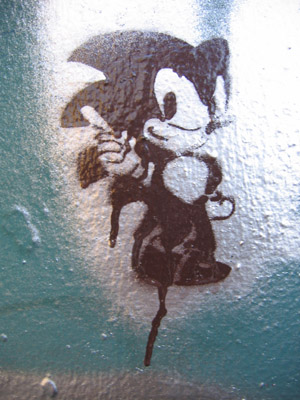
20 Arcade, Video and Computer Game Graffiti Artworks

Graffiti art is often an expressive, albeit illegal, way for street artists to express their opinions on social and political affairs. However, sometimes graffiti artist create fan art of celebrities, movies or computer games. This street fan art is simply a way of expressing appreciation for characters that have become a part of the artist's life.


Classic Arcade Games in Graffiti Art

Classic arcade games like Tetris, Space Invaders and Pacman have memorable, pixellated characters or objects that frequently find their way into graffiti fan art. The pixels can be created out of paint, tiles or painted squares of materials such as cardboard or wood.

Above: Fan art graffiti of the arcade game Tetris, made using colorful plastic packing crates.

Above: This gaming graffiti piece uses craft mosaic tiles to create a pixellated image of the alien characters from the arcade game, Space Invaders.


Classic Video and Computer Games in Graffiti

Besides arcade games, there are a number of classic computer games that have found their way into street artworks. Mario Brothers, The Legend of Zelda, Lemmings and Worms were a staple diet for gamers back in the late 80s and 90s. With the advent of gaming consoles, gamers could play their favorite games from the comfort of their own homes instead of going out to an arcade.


Above: These tile mosaics show Mario from the popular Nintendo game, Mario Brothers, in a classic, pixellated style.


Above: This piece of street art uses beer coasters to create a pixel image of Link from the Legend of Zelda.


Above: Lemmings painted on a bridge over a busy road way. Several lemming graffiti pieces have popped up around the world, usually on bridges over freeways and highways. The artworks are often accompanied by the phrase, "Hello Lemmings!"


Above: A classic Worms character greets pedestrians from a street corner. The game's graphics changed drastically with the introduction of Worms 3D.


Recent Games

The current gaming industry focuses heavily on graphics. Computer games and console games now have highly detailed scenes and characters that present new challenges for game playing graffiti artists. Spray paint, however, can create a smooth, 3D effect when used by a skilled graffiti artist. Luckily there are many games that use a cartoon style for their characters, making a graffiti rendering of the characters easier for street artists.


Above: Graffiti artworks showing characters from Street Fighter.


Above: Commissioned graffiti depicting an image from the video game, Halo, followed by an artist's interpretation of a Halo character.


Above: Samus Aran, the bounty hunter from the video game series Metroid.

Above: The Sony Corporation commissioned several graffiti artworks to advertise their new product, the PSP. The googly-eyed cartoon characters are each holding a PSP.


Above: Bioshock graffiti art


Above: A spray-painted 22nd Century vehicle from the game R-Type


Above: Large graffiti piece of Starcraft's Typhus, smoking a cigar. Artists' mediums like spray cans and air brush canisters allow for a soft, smoky effect.


Above: Grand Theft Auto graffiti


Read More on Art-Sci:
 3-D Graffiti Sculptures Hit the Streets 
 Graffiti: Art or Vandalism? 
 Performance Artist or Just Another Weirdo?  
 Photoshop Humanoids
 Tattoo Humor: Mooning Belly Buttons 
 Tattoos That are Invisible in Daylight 

Monday, November 29, 2010

Amazing Origami Fan Art of Comic, Film and Gaming Characters

Origami, the traditional Japanese art of paper folding, has been used to create fan art figurines of popular characters.


Origami is a term used for the art of creating a 3D object from a single square piece of paper. The term “Origami” comes from the Japanese words, “Oru” – folding and “Kami” – paper, so the word “Origami” literally means paper folding.


Traditional Origami Crane Design

The art style has its origins in ancient Japan, traditionally using flowers, birds, frogs and dragons as subject matter. The most famous traditional Japanese design is the origami crane.
Modern origami artists challenge themselves with newer subject matter, such as automobiles, sci-fi aircraft and fantasy architecture. Fan art origami is a recent addition to the world of origami, featuring stunning paper models of characters from films, computer games and comic books.


Lord of the Rings Origami by Eric Joisel

The characters from JRR Tolkien’s “Lord of the Rings” have inspired many fan art pieces. These origami models of the characters are technically difficult and highly detailed, so the project takes more time and effort than many forms of fan art.


Gandalf the Grey

Eric Joisel, born in 1956, is a French Origami artist. His creative designs have an organic, sculptured feel to them. Each paper sculpture is folded from a single piece of paper; following the rules of Origami purism which states that the paper must not be cut or torn in any way to assist the artistic process.

Joisel’s characters are not only highly detailed; they also reflect the character’s personality through pose. This effect is extremely difficult to achieve, but the result is an amazingly accurate and realistic character model.
Creating such intense detail requires a lot of planning ahead and concentration. Mistakes in origami are often irreversible, and the artist will have to start over with a fresh piece of paper.

See more stunning origami designs from Eric Joisel here.


Fan Art by Brian Chan

Movies play a large role in fan art, inspiring artists to sketch, paint, sculpt and build replicas of their favorite movie characters out of a variety of materials.

V for Vendetta Mask

Brian Chan is an avid origami artist who creates a variety of origami fan art pieces, insects, animals and flowers. This life-size mask inspired by the movie “V for Vendetta” can be used as an original Halloween mask, or an indoor decoration.


Bat Symbol from the Batman Comic Books and Movies

Inspired by the movie “Batman Begins”, Chan designed an origami model of the Bat Symbol. Origami can be used to create 3-dimensional models, but some subjects like the Batman logo require a flat, 2-Dimensional effect.


Pixar's Wall-E Character Model

Wall-E, a robot from the Disney/Pixar animated movie takes on a new form through this origami model. This design uses characteristic poses of the Wall-E figure to emphasize the lovable personality of the popular character. Even though the movie was aimed at children, adult audiences are enjoying a variety of fan art stemming from the film.


Iron Man from Marvel Comics

Marvel Comics character Iron Man has a fairly simple color structure of red and yellow, which makes the origami artist’s job a lot easier. Complex colors in a design can be difficult to achieve in origami, because a sheet of origami paper generally has only one color for each side
Origami artists will sometimes paint the finished model to give it more detail, but the challenge is to create these details without painting the finished figurine.


Rei Ayanami from Neon Genesis Evangelion

The famous and often plagiarized character Rei Ayanamie has a complex color design. An origami artist could use multiple sheets of paper to give the model more color, but in this instance, Chan has opted to use a single piece of paper for a graceful, fluid look. To add more color, he has painted the finished model.
Check out Brian Chan’s origami website.


Final Fantasy Characters Origami by Satoshi Kamiya
Computer and console game characters inspire a lot of fan art, the most unique being 3D sculptures and models, whether they are made from Lego, modeling clay or paper.

Chocobo

This design by Satoshi Kamiya is of Chocobo from the popular game, Final Fantasy. The characters in Final Fantasy are complex and highly detailed, but this master origami artist has created a convincing likeness of the character from a single piece of paper.


Bahamut

This is another stunning design by Satoshi Kamiya of Bahamut, Dragon Lord, from the game Final Fantasy. Satoshi used clever folding to recreate the muscle structure of Bahamut, creating a powerful replica of the masculine dragon character.


Fenrir

Four-legged origami creatures are easier to balance than bipeds, but heavy tails and heads need to be weighted correctly so that the character can stand alone without support. Yet another gaming character from Kamiya, this model is a believable replica of Fenrir from Final Fantasy.
Kamiya was born in 1981 and started folding paper at age two. View his site here.


Read More on Art-Sci:
 10 Amazing Cake Designs
 Where's Waldo? Where's Wally? Where's Walter?